From platform promise to first-in-class IND.
Led a 20-person cross-functional team through the development path for a PSMA-targeted nanoparticle oncology program.
Turning complex development challenges into aligned, actionable strategy.
Oncology drug-development and program leader with 25+ years across the full lifecycle — first-in-human to approval. I connect clinical science, operations, regulatory, and portfolio execution, then build practical tools that make complex work clearer and easier to verify.
Different organizations, different development stages, one operating pattern: clarify the critical decision, align the disciplines around it, and move the program toward a defensible milestone.
Led a 20-person cross-functional team through the development path for a PSMA-targeted nanoparticle oncology program.
Managed approximately 100 global sites at 95% data-quality compliance while contributing to the niraparib prostate-cancer program and its FDA Breakthrough Therapy Designation.
Re-engineered an oncology basket-study protocol, reducing projected start-up time by four months and program cost by 15%.
I work where clinical science and program leadership meet—connecting the evidence, the operating plan, and the people accountable for the next milestone.
Converting science into clear, executable development strategy.
On a given program I have authored the protocol, served as medical monitor and signatory, and also owned the timelines, teams, budgets, risks, and governance that carry the work forward.
My foundation spans nine years building the clinical-translational function at BIND Therapeutics, four years at Janssen Oncology across Phase II/III programs, and senior clinical-science, medical-monitoring, advisory, and program-leadership roles across emerging biotech.
I am equally comfortable in the regulatory lane—protocol, investigator-brochure and IND/CTA authorship, health-authority responses, inspection readiness, and a RAPS Foundation in Regulatory Affairs.
Phase I–III protocol leadership, medical monitoring, benefit-risk review, and clinical decision-making.
Integrated plans, governance, budgets, dependencies, and cross-functional alignment from pre-IND onward.
Submission-ready documents, database remediation, SAP/DSUR standards, and inspection-ready oversight.
Leadership across founders, global pharma, consultants, CROs, CDMOs, investigators, and internal functions.
Why “Clarity Forward.” Caring for my mother through a rare cancer and my father through neurodegenerative disease reinforced a standard I carry into every program: in medicine, clarity is care. Behind every endpoint is a family waiting for an answer.
Cures are rare. They were never the only point.
The point is time.
Time for one more birthday — a grandmother at the kitchen table, candlelight and the sweet smell of vanilla frosting, everyone singing a little off-key. Her five-year-old granddaughter climbs into her lap, one small hand resting over the blue veins in her wrist, never noticing the tremor in the arm around her waist. Together they blow out the candles.
For a moment, the grandmother disappears behind the smoke. Then she is there again, laughing.
Time for one more June — a grandfather in the bleachers, a folded program damp in his palm, knees aching, waiting through a hundred names he will never remember. Then the announcer calls the one he came for — his grandson's name, which is also his own — and the pride rises faster than he can hold it back. His grandson steps onto the stage, gown loose at the shoulders, cap tilted slightly to one side, and turns toward the stands, searching.
Then he finds him.
The work does not always end in a cure. Sometimes it means slowing what cannot be stopped — another month, another year, another ordinary morning. Enough time to still be there when someone you love looks for you.
That is the difference. Not always more years — sometimes simply more life inside the years that remain.
Twenty-five years of breadth across the drug-development lifecycle — a versatile leader who integrates clinical science, operations, regulatory, and program management, and steps into whatever a program needs. Woven across roles from BIND and Janssen to TORL and K36.
Authored and revised dozens of clinical protocols across Phase I–III oncology and other therapeutic areas. Served as medical monitor across numerous studies — including protocol author and signatory on first-in-human programs — providing clinical oversight, patient-safety review, and inspection-ready medical governance across program teams.
Built, remediated, and locked clinical databases for data integrity and inspection-readiness across multiple studies and sponsors. Established clinical data standards underpinning SAPs and DSURs, and deployed real-time medical- and safety-review tooling (e.g., JReview) to keep programs audit-ready.
Authored protocols, investigator brochures, IND/CTA components, and health-authority responses across 30+ submission-ready programs. Led pharmacovigilance and regulatory strategy in partnership with sponsors and large pharma. RAPS Foundation in Regulatory Affairs.
Led clinical development and portfolio governance from early formulation through Phase III — across emerging biotech and global pharma. Directed multi-indication oncology programs and trial delivery at ~100-site scale, secured regulatory designations and approvals (including a Breakthrough Therapy Designation), and re-engineered programs to cut timelines and cost.
Twenty-five years centered on oncology drug development — extended, through advisory work, into rare disease, immunology, and beyond.
Solid tumors and hematologic malignancies, including antibody-drug-conjugate, nanoparticle, epigenetic (NSD2), targeted, and immuno-oncology programs — spanning clinical science, medical monitoring, and program leadership.
RAPS Foundation in Regulatory Affairs (FRA), 2025 — formal grounding for the protocol, IB, IND, and health-authority work I lead day to day.
13 publications and a granted patent family in oncology drug development — selected below.
First or contributing author across nine society abstracts. Full citation list available on request.
Excerpts from written letters of recommendation by senior oncology leaders who know the work firsthand.
“Without a doubt, Jason is one of the very best clinical development individuals I have ever had the opportunity to work with. He always delivers.Daniel D. Von Hoff, MD, FACPPhysician-scientist, oncology drug development · TGen · City of Hope
“Jason's unique blend of strategic insight, technical acumen, and collaborative spirit is very unique… I am confident he will exceed your expectations.Anthony W. Tolcher, MDCEO & Founder, NEXT Oncology
“Within a short time of starting with us, he provided insights, recommendations and contacts from within his professional network that to this day maintain a recognizable positive impact on our program… I would urge your organization to consider his candidacy seriously.Matthew R. PriceEVP & COO, Promontory Therapeutics
Perspectives on oncology development, program leadership, and making consequential decisions under uncertainty.
Early evidence becomes strategy only when a team is explicit about what it knows, what it assumes, and what decision comes next.
A promising signal can create momentum before it creates clarity. The leadership task is to turn incomplete evidence into a disciplined next decision—without overstating certainty or slowing the program into paralysis.
Read the full insightOperational feasibility is not downstream from oncology development strategy. It determines whether a trial can produce an interpretable answer.
Read the full insightGovernance creates value when it turns complex program evidence into explicit choices, accountable decisions, and a clear path forward.
Read the full insightEffective oncology medical monitoring connects patient-level judgment to protocol intent, emerging evidence, and the program’s next decision.
Read the full insightWhen an oncology program loses momentum, recovery begins by making the evidence, ownership, and critical path explicit.
Read the full insightI translate domain problems into working decision-support software: deterministic where the answer must be reproducible, AI-assisted where interpretation adds value, and designed around human review. These are independent capability demonstrations—not sponsor systems or production medical software.
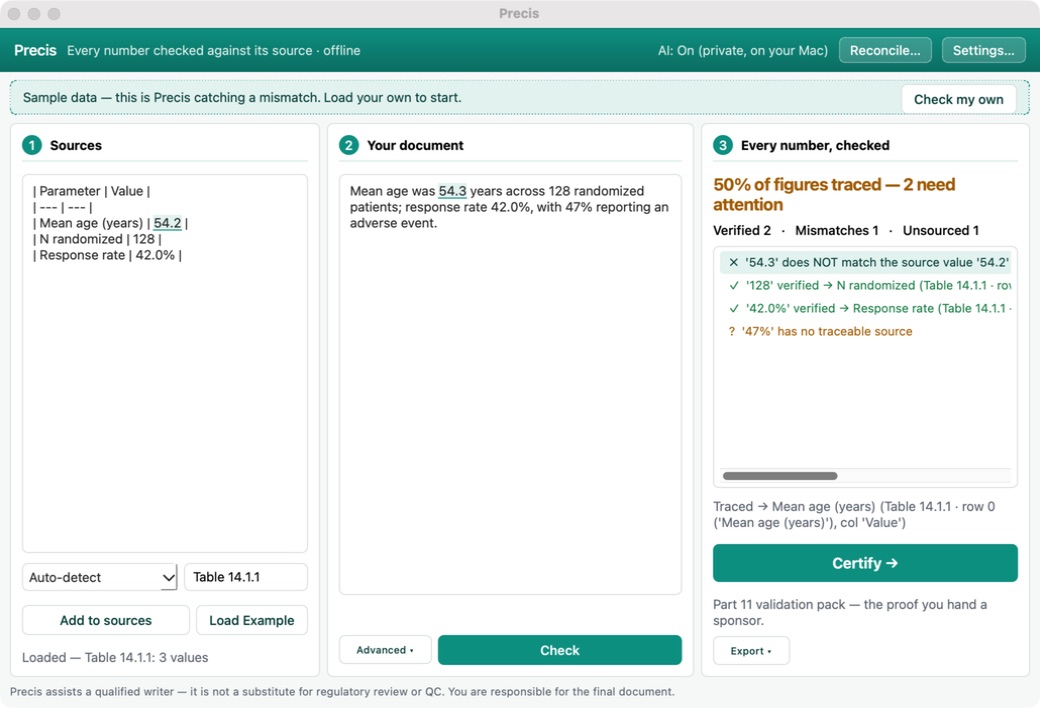
Checks regulatory drafts against source tables and CDISC datasets, classifies figures as verified, mismatched, or unsourced, and preserves a click-through audit trail. The engine never rewrites a number or invents one.
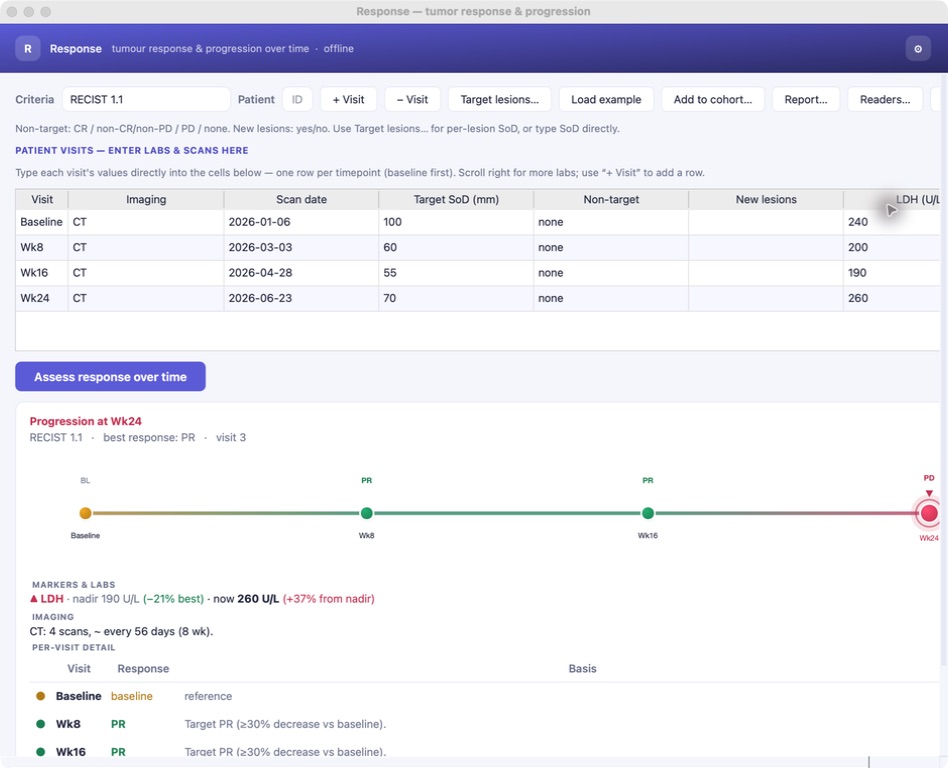
Walks longitudinal imaging and laboratory data across RECIST 1.1, iRECIST, IMWG, and PCWG4; identifies best response and confirmed progression; and cites the rule behind every classification.
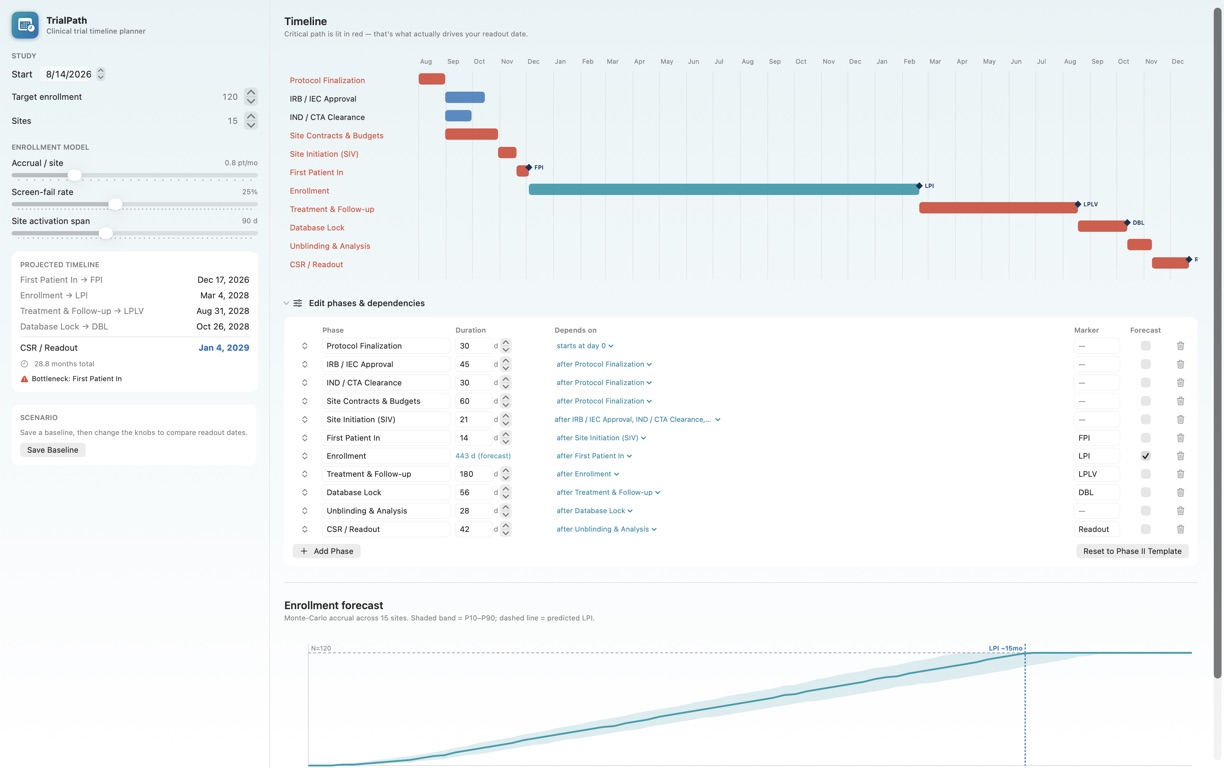
Connects phase dependencies, site activation, screening, enrollment, follow-up, database lock, and readout on one critical path—then models milestone uncertainty instead of presenting a single optimistic date.
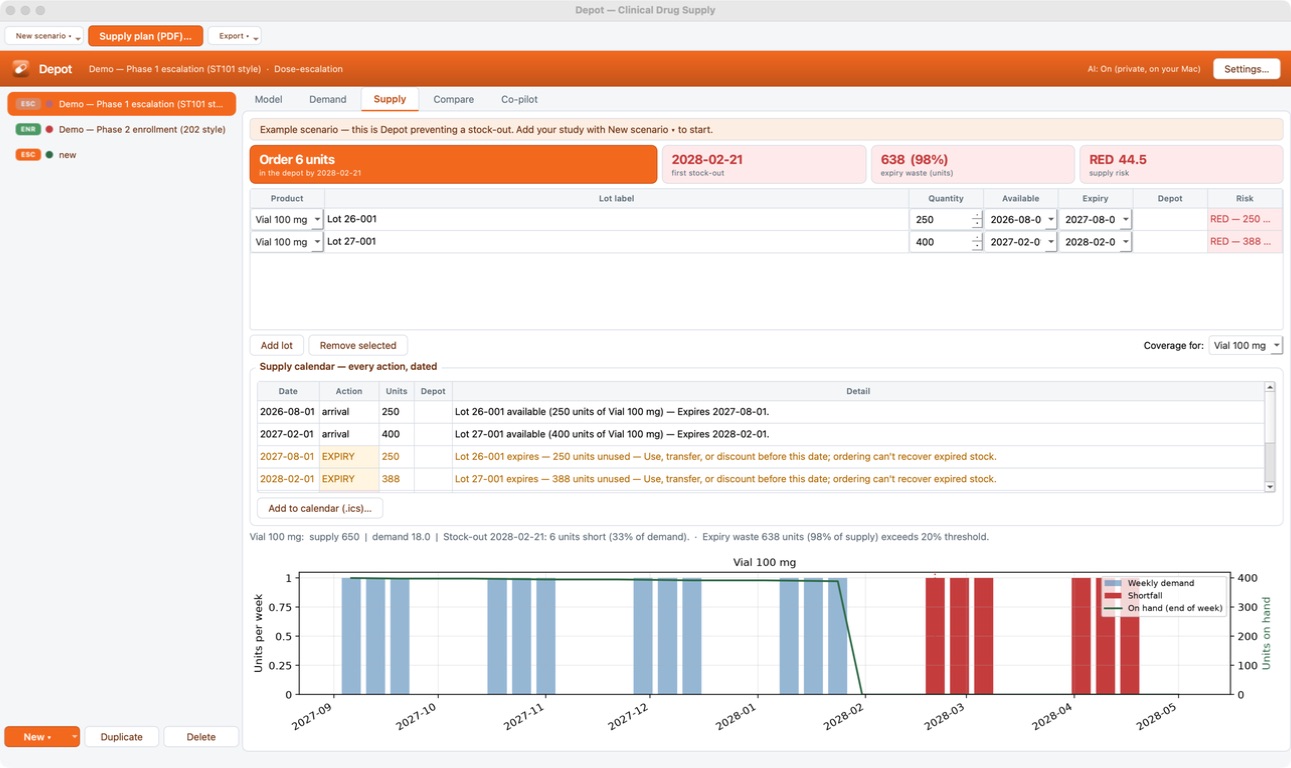
Forecasts investigational-product demand, tracks FEFO coverage and expiry exposure, simulates uncertainty, and identifies the first stock-out. The output is an operational handoff: what to order, how much, and by when.
All interfaces shown with synthetic or built-in example data. Tools were built independently as capability demonstrations; no confidential, patient, or sponsor data is used. Walkthroughs are available on request.
I am considering the right senior full-time leadership opportunity and, selectively, focused advisory engagements where experienced judgment can move a program forward.
For organizations seeking an experienced leader who can connect clinical strategy, scientific judgment, operational execution, and the portfolio decisions behind a consequential development program.
Senior-level support for a defined decision, inflection point, or recovery effort—with a clear mandate, disciplined scope, and practical deliverables.
If there may be a fit, let's compare notes. I share a tailored executive CV directly, with the experience and context most relevant to the opportunity.