Many governance meetings are full of information and short on decisions. Every function reports, every risk has a slide, and the meeting ends with more actions—but the central choice remains unresolved.
This is not a presentation problem. It is a decision-design problem.
In an oncology portfolio, evidence changes quickly, uncertainty is unavoidable, and several programs may compete for the same capital, patients, people, and leadership attention. Governance must do more than create visibility. It must provide a disciplined way to choose what the organization will do, what it will defer, and what it will stop.
More reporting does not create more clarity
Program reviews often grow by accumulation. A new issue adds a slide. A new function adds a section. A difficult question generates a follow-up analysis. Over time, the deck becomes comprehensive while the decision becomes harder to see.
Good governance reverses that logic. It begins with the choice leadership must make and includes the evidence required to make it. Detail remains available, but it is organized around the decision rather than around the reporting structure of the company.
This does not mean simplifying a complex program into a superficial score. It means distinguishing information that changes the choice from information that merely describes the work.
Name the decision before building the review
A decision request should be specific enough that participants know what authority is being exercised. “Review the program” is not a decision. “Select the expansion strategy,” “approve the investment required to reach the next value inflection,” or “determine whether the current evidence supports continued development” is.
Before the meeting, the team should be able to state:
- The decision: what leadership is being asked to choose.
- The decision owner: who has authority and accountability for the outcome.
- The timing: why the choice is needed now and what is lost by delay.
- The options: the credible paths available, including defer or stop when appropriate.
- The recommendation: the proposed choice and the reasoning behind it.
When these elements are missing, discussion tends to expand without converging. When they are explicit, disagreement becomes useful because participants can challenge the evidence, assumptions, and tradeoffs that actually support the recommendation.
Give leaders the anatomy of the choice
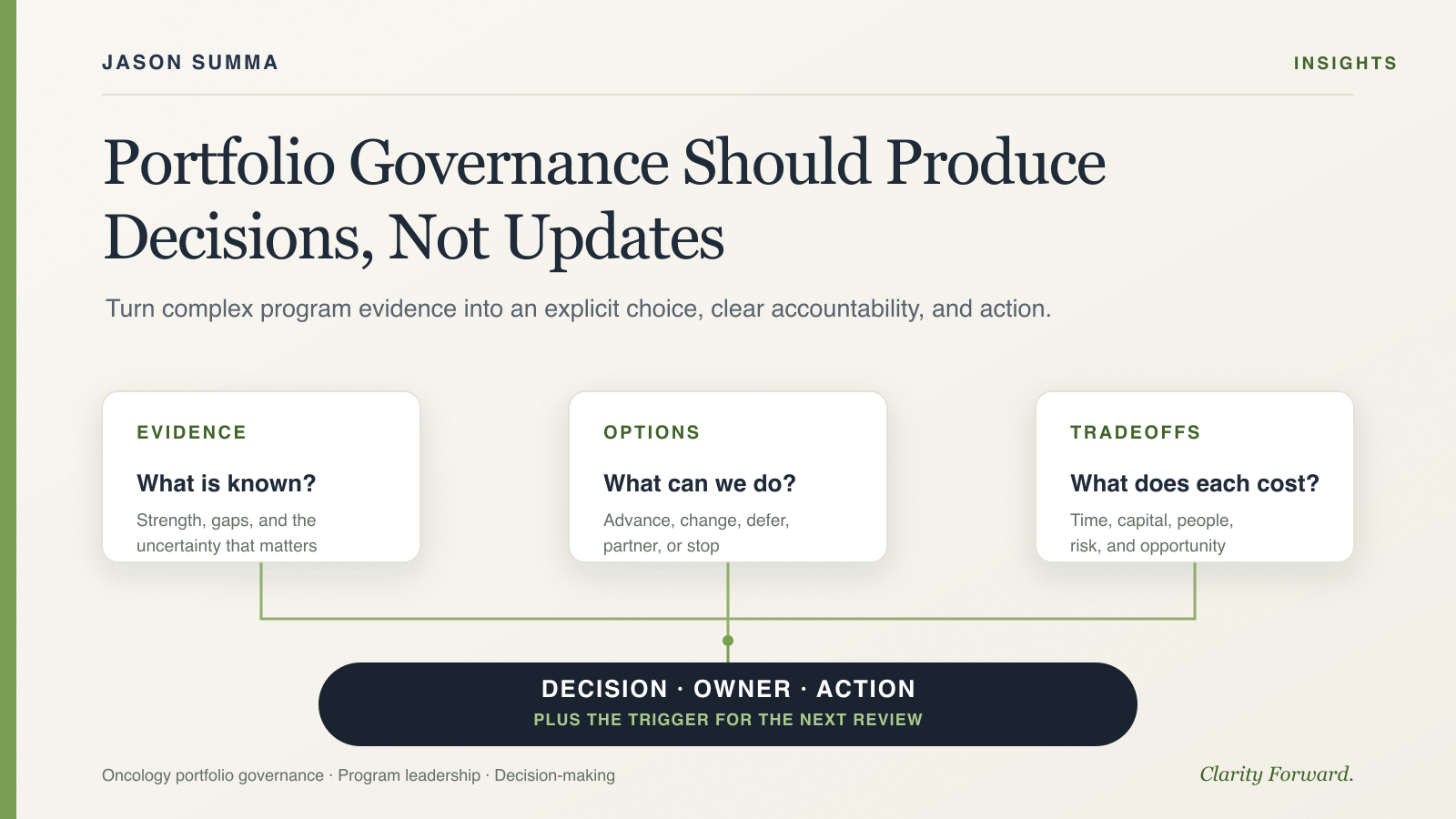
A decision-ready review brings three kinds of information together: the evidence now available, the viable options, and the tradeoffs created by each option.
Evidence
What is known, how reliable it is, and which uncertainties remain consequential.
Options
The credible paths forward, including the implications of waiting or stopping.
Tradeoffs
What each path requires, enables, delays, displaces, or puts at risk.
The recommendation should follow from that anatomy. It should explain not only why one option is preferred, but also why the alternatives are not. That comparison matters because most consequential portfolio decisions are made among imperfect choices, not between an obviously correct path and an obviously wrong one.
Compare programs consistently without pretending they are equivalent
Portfolio decisions require a common language, but oncology programs are not interchangeable. An early platform program, a registration-enabling study, and a lifecycle opportunity may carry different evidence standards, time horizons, strategic roles, and forms of risk.
A useful portfolio framework applies consistent dimensions while preserving that context. Those dimensions may include strength of evidence, unmet need, differentiation, development feasibility, regulatory path, time and cost to the next meaningful milestone, probability and consequence of key risks, and strategic fit.
The purpose is not to manufacture a single number that appears to resolve judgment. It is to make the basis of judgment visible. A score can support discussion; it should not conceal the assumptions or value choices beneath it.
Make resource tradeoffs explicit
A portfolio decision is also a resource decision. Advancing one program may consume clinical sites, translational capacity, regulatory attention, capital, or executive bandwidth that another program needs. Yet governance discussions often evaluate each proposal in isolation, as though approval has no opportunity cost.
Leadership should see what the recommended path requires and what it displaces. If an accelerated timeline depends on additional people or external spending, that dependency belongs in the decision. If maintaining multiple options delays a decisive experiment, that cost should be visible as well.
Making tradeoffs explicit improves both the quality and the durability of the decision. Teams understand not only what was chosen, but the organizational commitment the choice represents.
Protect the meeting from false consensus
Cross-functional alignment does not require every discipline to view the evidence in the same way. Clinical, translational, safety, regulatory, operational, commercial, and financial perspectives may legitimately produce different concerns.
Effective governance surfaces those differences before the meeting and presents them fairly. A recommendation is stronger when it identifies the central dissent, explains which uncertainty drives it, and shows how the proposed path will test or manage that uncertainty.
When disagreement is compressed into a green status indicator, leaders may believe they are approving a shared plan when they are actually inheriting unresolved assumptions. Explicit dissent is not dysfunction. Hidden dissent is risk.
A decision needs an operational afterlife
The value of governance is realized after the meeting. A decision should leave behind a clear record: what was decided, who owns the next action, which resources were authorized, what assumptions the decision relies on, and when the organization will revisit it.
This record should be concise and accessible. It prevents teams from relitigating settled questions, helps new participants understand the reasoning, and allows leadership to distinguish a poor decision from a sound decision undermined by failed execution or changed evidence.
It also establishes the trigger for the next governance moment. The program should return when a defined milestone is reached, a critical assumption changes, a threshold is crossed, or an external event materially alters the choice—not simply because the calendar calls for another update.
Governance is a leadership system
High-quality governance does not eliminate uncertainty or make difficult choices painless. It creates a repeatable way to face them. The organization sees the evidence in proportion to its strength, compares credible alternatives, understands the tradeoffs, assigns accountability, and knows what will cause the decision to be revisited.
This is especially important in oncology, where the cost of ambiguity is measured not only in budget and timeline, but in the opportunity to generate evidence for patients who are waiting.
Updates describe where a program has been. Governance decides where the organization will take it next.