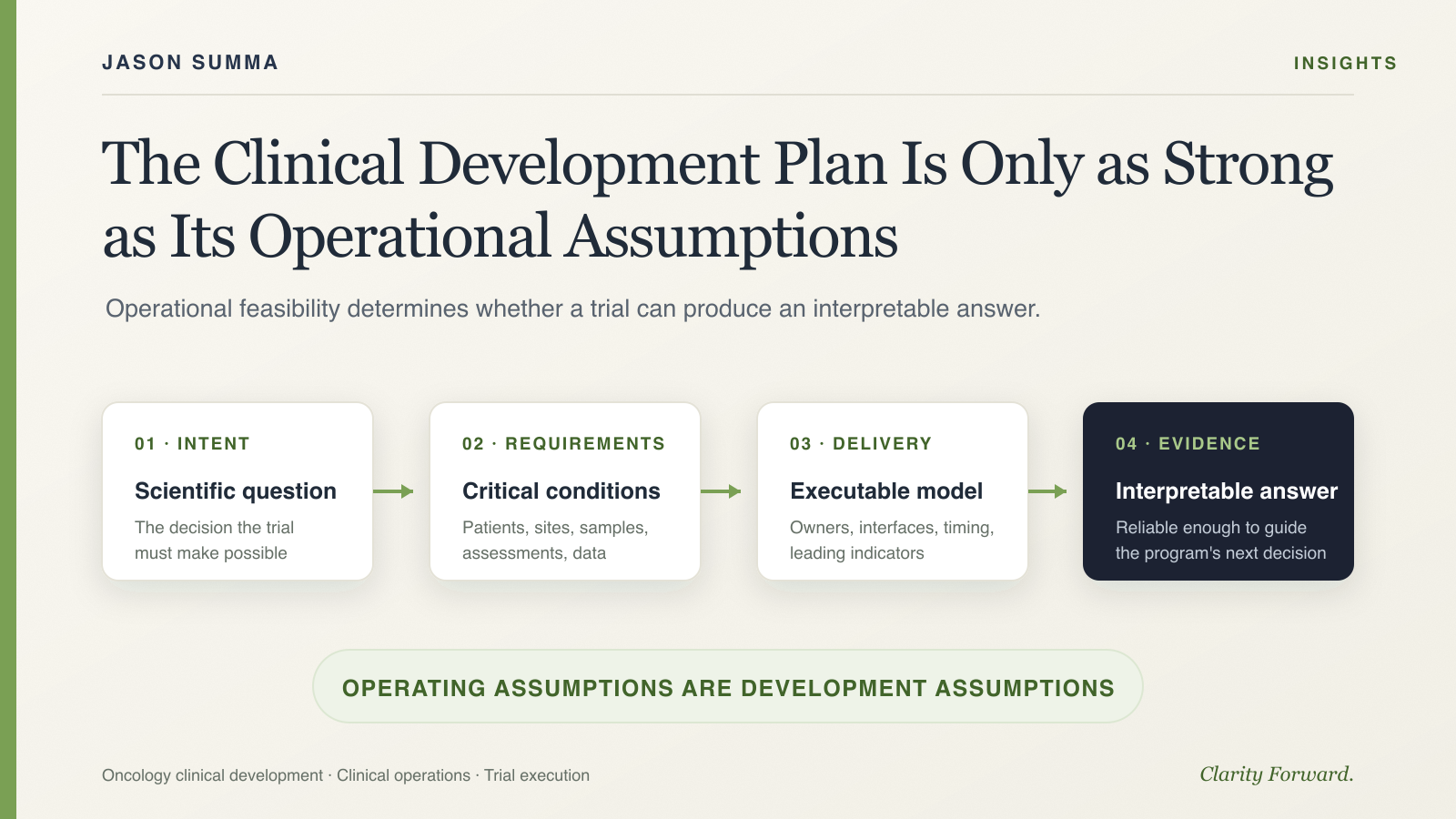
An oncology protocol can be scientifically persuasive and still fail to answer its central question. The failure often begins before the first site opens, when operational assumptions are treated as details to resolve after the strategy is set.
The distinction between clinical development and clinical operations is organizationally convenient. It is not how evidence is generated. Population, assessments, samples, sites, data flow, safety review, and decision timing are one connected system. If any critical part of that system is unrealistic, the development plan inherits the weakness.
The leadership task is to make those assumptions visible early enough to improve the design—before they become amendments, delays, missing data, or conclusions the study cannot support.
Strategy fails where assumptions remain invisible
Most development plans contain an operational model whether or not the model is written down. The plan assumes that the intended patients can be identified, that investigators will accept the design, that sites can complete required procedures, that samples will be usable, that data will arrive at the right cadence, and that vendors can execute within the proposed timeline.
Those assumptions are not secondary to the clinical hypothesis. They determine whether the hypothesis can be tested.
A disciplined team therefore asks more than whether a protocol is scientifically defensible. It asks which conditions must hold for the study to generate interpretable evidence, where those conditions are most fragile, and how the design can reduce dependence on optimism.
Translate every development question into an execution requirement
A useful way to connect strategy and execution is to translate each important development question into the conditions required to answer it.
Question
What decision must the evidence support, and in which patient population?
Requirement
Which assessments, samples, time points, sites, and data are essential to that decision?
Proof
What early operating evidence will show that the study can deliver the intended answer?
If dose selection depends on integrated safety, exposure, pharmacodynamic effect, and preliminary activity, then the plan must specify how quickly each data stream becomes reviewable and how they will be evaluated together. If a biomarker-defined population is central to the thesis, the plan must address tissue availability, assay performance, turnaround time, screen-failure risk, and the site workflow required to identify those patients.
This translation exposes design choices that otherwise appear only after activation. It also helps the team distinguish requirements that are essential to the decision from complexity that has accumulated without a clear purpose.
Interrogate enrollment—do not merely quote a rate
An enrollment forecast can look precise while resting on weak assumptions. A monthly rate is the output of a model, not an explanation of why patients will enter the trial.
For an oncology study, the more useful discussion begins with the patient pathway. How many potentially eligible patients does a site actually see? At what point are they identified? Which competing trials or treatment options are available? What proportion will have the required tissue or biomarker result? What procedures may deter participation? How does the standard-of-care sequence affect the enrollment window?
Country and site counts matter, but they do not substitute for this reasoning. Leadership should understand the assumptions beneath the forecast, the evidence supporting them, and the leading indicators that will reveal early whether they are holding.
Treat data flow as part of study design
A trial does not generate decision-ready evidence simply because an assessment occurred. Data must be entered, cleaned, reconciled, reviewed, and interpreted in time to support the next action.
That makes data latency a strategic variable. Safety escalation, dose decisions, cohort expansion, protocol adaptation, and governance reviews all depend on an explicit rhythm for data availability. When that rhythm is vague, teams often discover that their decision calendar is built around data they cannot yet trust.
The plan should identify the critical data, the expected time from clinical event to reviewable record, the ownership of outstanding issues, and the point at which the dataset is sufficiently complete for the intended decision. This is especially important when multiple systems, central laboratories, imaging vendors, pharmacokinetic analyses, and safety processes must converge.
Put external partners inside the operating model
A sponsor can delegate activities, but it cannot delegate accountability for the development question. CROs, laboratories, imaging providers, depots, and other partners should therefore be integrated around the evidence the program needs—not managed as separate streams of task completion.
Effective oversight clarifies interfaces: which handoffs are critical, what quality signal will be monitored, where decisions can become trapped between organizations, and who acts when performance departs from plan. Vendor status should not be reduced to whether milestones are green. The more important question is whether partner performance is protecting the interpretability and timing of the study.
Use leading indicators before outcomes are at risk
Lagging measures tell a team what has already happened: enrollment missed, data cleaning delayed, samples lost, or a milestone moved. Strong clinical operations also tracks the conditions that precede those outcomes.
Depending on the trial, those indicators might include activation cycle time, patient-identification activity, screen-failure reasons, assessment completion, sample viability, data-entry latency, query aging, protocol deviations, monitoring findings, or investigational-product coverage. The point is not to create a larger dashboard. It is to identify the small set of signals that show whether the development assumptions remain credible.
When these indicators are tied to owners and predefined responses, the team can intervene while options still exist. Without them, governance receives a polished explanation after the consequence is already embedded in the timeline.
Operational readiness is part of scientific integrity
Clinical operations is sometimes described as the machinery that implements a scientific plan. In practice, it shapes the reliability of the evidence and the confidence that can be placed in the conclusion.
A strong development strategy therefore connects four elements: the scientific intent, the operational requirements created by that intent, an executable delivery model, and a defined path from incoming data to decision. Each element should be challenged before the study begins and revisited as the program learns.
The protocol states the question. The operating model determines whether the program will receive a trustworthy answer.