A promising early signal can change the energy around an oncology program almost overnight. It can also create pressure to move faster than the evidence can support.
The understandable response is momentum: expand a cohort, add an indication, accelerate the next protocol, or begin describing a regulatory path. But an early signal is not yet a development strategy. It is an invitation to make the next decision with more discipline.
The leadership challenge is neither to suppress enthusiasm nor to convert it prematurely into certainty. It is to establish what the evidence actually shows, identify what remains unresolved, and design the next step so that the program becomes more decision-ready.
The signal is not the strategy
Early oncology data are generated in a setting built for learning, not for delivering a final answer. Patient populations may be heterogeneous. Exposure can vary. Follow-up may be short. Doses, schedules, combinations, and eligibility criteria may still be evolving. A small number of responses can be important without yet being definitive.
None of this diminishes a promising observation. It clarifies the work required to interpret it responsibly.
A strategy begins when the team can explain why the signal matters, which alternative explanations remain plausible, and what evidence would change the program’s direction. Until those elements are explicit, the organization may have enthusiasm, activity, and a timeline—but not yet a shared decision framework.
Start with the decision, not the next activity
Development teams often move quickly into execution: protocol concepts, site plans, vendor discussions, and budget scenarios. Those activities are necessary, but they should follow a clear statement of the decision the organization expects the next body of evidence to support.
Before selecting the next activity, leadership should be able to answer four questions:
- What decision is ahead? Continue, expand, narrow, combine, reposition, partner, or stop?
- What evidence is essential to that decision? Safety, exposure, pharmacodynamic effect, durability, activity in a defined population, operational feasibility, or some combination?
- What result would materially change the path? The threshold should be discussed before the data arrive, not reconstructed afterward.
- What uncertainty can the organization responsibly carry? Not every question must be answered immediately, but unresolved uncertainty should be visible and owned.
This shift—from scheduling the next study to defining the next decision—helps prevent a common failure mode: generating more data without generating more clarity.
Separate what is observed, inferred, and assumed
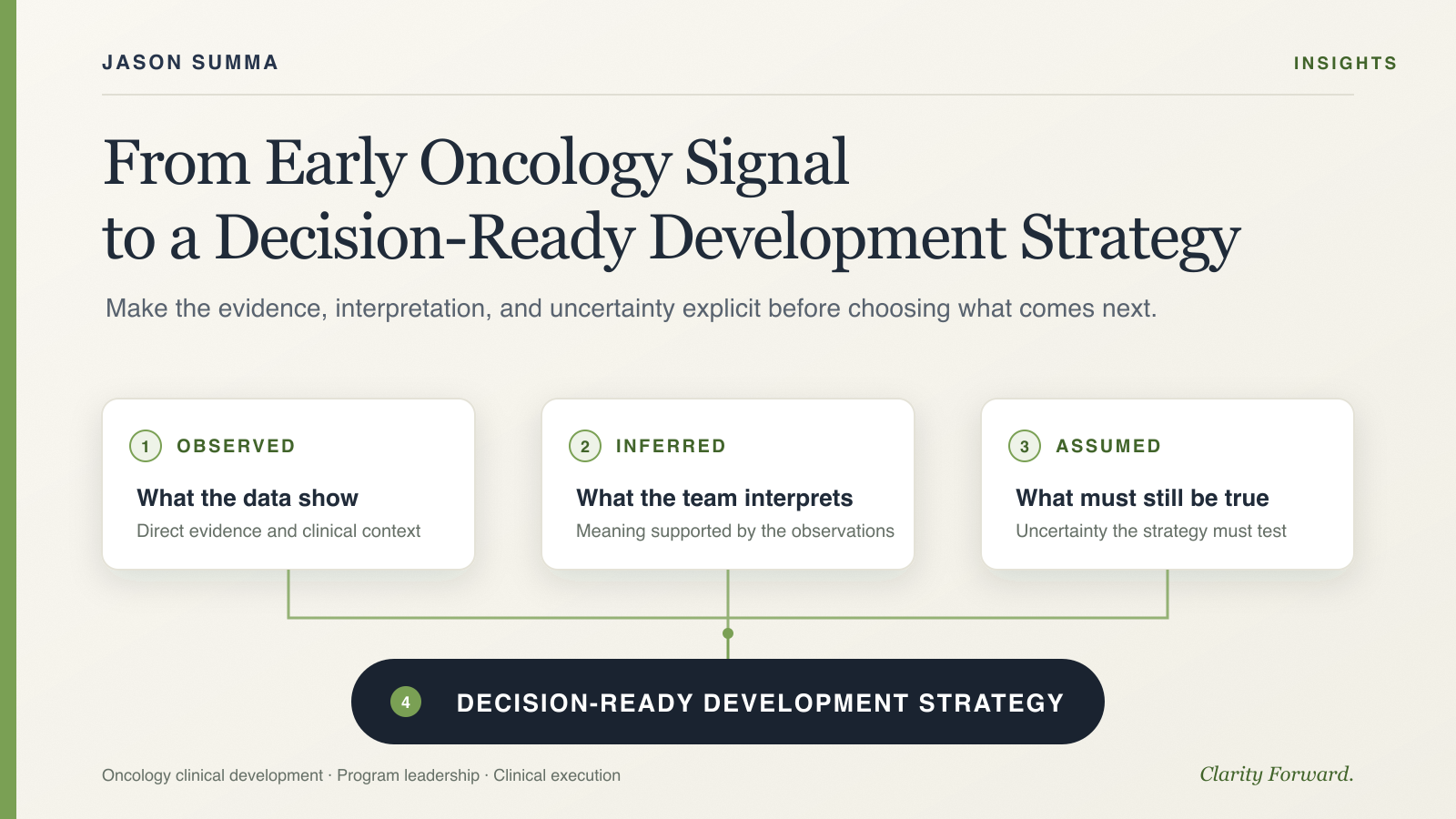
One of the simplest ways to improve an early program discussion is to separate three categories that are frequently blended together.
Observed
What the data directly show: safety findings, exposure, pharmacodynamic effects, tumor measurements, duration, and the clinical context in which they occurred.
Inferred
What the team reasonably interprets from those observations: evidence of target engagement, a possible dose relationship, or activity in a biologically coherent subgroup.
Assumed
What must still be true for the development thesis to hold: reproducibility, differentiation, feasible enrollment, an acceptable therapeutic window, or a viable regulatory path.
The purpose is not semantic precision for its own sake. It is to keep confidence proportional to evidence. When an inference is presented as an observation, or an assumption becomes embedded in the operating plan, teams can commit resources without recognizing the risk they are accepting.
A decision-ready strategy makes these categories visible. It also defines how the next stage will test the most consequential assumptions rather than merely accumulate additional observations.
Make clinical science and clinical operations one conversation
A scientifically elegant question has limited value if the trial cannot answer it cleanly. Conversely, an operationally efficient study can still fail the program if its design does not produce interpretable evidence.
This is why clinical science and clinical operations should shape the next strategy together, early. The target population, eligibility criteria, assessment schedule, biopsy strategy, site profile, geographic footprint, data-review cadence, and enrollment assumptions all affect what the program will be able to conclude.
The dialogue should be concrete. Can sites identify the intended patients reliably? Will required samples be obtainable in the relevant setting? Can critical assessments be completed consistently? Will the data arrive soon enough to guide dose or cohort decisions? Are the operational assumptions compatible with the proposed timeline?
These are not implementation details that follow strategy. They are part of the strategy because they determine whether the scientific question can actually be answered.
Use governance to resolve tradeoffs—not merely report progress
Early programs rarely suffer from a shortage of possible work. They suffer from too many plausible paths competing for limited patients, time, capital, and organizational attention.
Effective governance creates a forum in which those tradeoffs can be resolved. That requires more than a comprehensive slide deck. Leaders need a concise account of the evidence, the uncertainties that matter most, the alternatives considered, the resource implications, and the decision being requested.
Good governance also protects the organization from false consensus. Clinical, translational, regulatory, operational, commercial, and financial perspectives will not always point in the same direction. The goal is not to eliminate those differences. It is to surface them early enough that leadership can make a deliberate choice.
Define thresholds before the next results arrive
Retrospective interpretation is vulnerable to enthusiasm, sunk-cost thinking, and shifting standards. A stronger approach is to establish directional thresholds before the next dataset is available.
These thresholds do not need to imply mathematical certainty. They can define what would support expansion, what would require modification, and what would challenge the development thesis. They should include not only efficacy, but also safety, exposure, durability, biomarker performance, enrollment feasibility, data quality, and the competitive context.
When thresholds are explicit, the team can adapt without improvising its standards. The discussion becomes less about defending a prior plan and more about choosing the best path from the evidence now available.
Decision-ready does not mean certain
No early oncology program becomes free of uncertainty. Waiting for certainty would stop development altogether. The objective is different: make the uncertainty legible, determine which questions are consequential, and ensure that the next investment is designed to improve the decision.
A decision-ready strategy therefore has a recognizable shape. It states the next decision. It distinguishes observation from inference and assumption. It connects scientific intent to operational reality. It defines thresholds in advance. And it gives governance a clear choice rather than a collection of updates.
The early signal creates possibility. Leadership turns that possibility into a disciplined path forward.