Medical monitoring is often described as a set of safety responsibilities. In oncology development, that description is necessary—but incomplete.
A medical monitor reviews serious adverse events, eligibility questions, protocol deviations, dose modifications, and emerging safety data. Yet the real value of the role is not the number of reviews completed. It is the quality and timeliness of the clinical judgment produced from them.
Every patient-level decision sits inside a larger development question. Is the protocol protecting participants as intended? Is the emerging benefit-risk profile consistent with the development thesis? Are operational patterns obscuring the evidence? Does the program need to adapt?
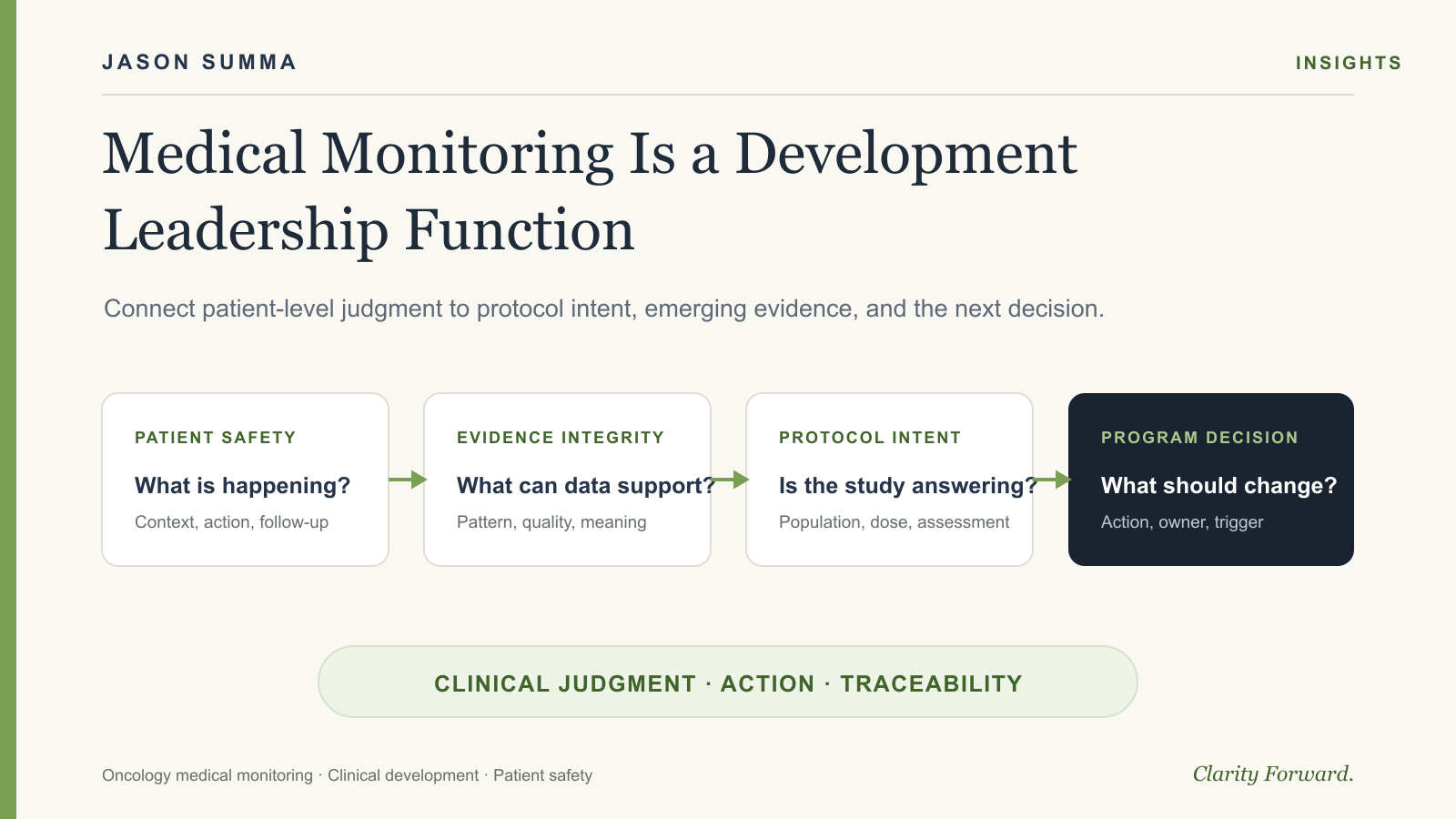
When medical monitoring is treated as a narrow safety checkpoint, those connections are easily lost. When it is treated as a development leadership function, the monitor becomes an integrator of patient safety, protocol intent, clinical evidence, and program decisions.
Safety review is the foundation, not the boundary
Protecting participants is the first obligation. But safety cannot be interpreted in isolation from disease context, mechanism, dose, exposure, concomitant therapy, expected toxicities, and the possibility of clinical benefit.
The same laboratory change can carry different meaning depending on timing, reversibility, competing explanations, and whether similar events are appearing across patients. A single event may require immediate action. A pattern may require a protocol change, a different monitoring schedule, a revised dose strategy, or a reassessment of the therapeutic window.
The medical monitor therefore has to read at three levels simultaneously:
Patient
What is happening now, what action is clinically appropriate, and what information is still needed?
Pattern
Is this isolated, expected, mechanistically coherent, operationally driven, or part of an emerging trend?
Program
What does the accumulated evidence imply for the protocol, benefit-risk assessment, and next decision?
Good monitoring moves among these levels without allowing the needs of the program to diminish the obligation to the individual patient.
Protect the question the protocol was designed to answer
A protocol is a scientific and operational instrument. Eligibility criteria, assessment schedules, dose-modification rules, response evaluations, and data-collection requirements exist because the study must produce an interpretable answer.
Medical monitoring protects that intent in real time. Repeated eligibility exceptions may indicate that the intended population is poorly represented in practice. Inconsistent dose modifications may compromise exposure interpretation. Delayed imaging, missing pharmacokinetic samples, or uneven attribution of adverse events can weaken conclusions even when enrollment appears to be progressing.
These are not separate “operations issues” to be handed off and forgotten. They are threats to the clinical question. The monitor’s job is to recognize when a patient-level or site-level issue is becoming a study-level issue and bring it into the program’s decision process.
This is also why medical monitoring and clinical operations should have a deliberate operating rhythm. As discussed in the connection between development plans and operational assumptions, execution determines whether scientific intent survives contact with the trial environment.
Build a decision rhythm, not a review queue
A monitoring model built around an inbox encourages episodic, transaction-by-transaction work. A development model creates a recurring cadence in which the accumulated evidence is interpreted.
That cadence should connect patient narratives, safety listings, dose and exposure, response data, protocol deviations, enrollment experience, and unresolved site questions. The purpose is not to add meetings. It is to make sure the right evidence reaches the right decision-maker before the program drifts.
Several practices materially improve that rhythm:
- Explicit decision rights. Sites, CROs, safety physicians, study leads, and the sponsor medical monitor should know who decides, who advises, and when escalation is required.
- Predefined clinical thresholds. Events and patterns that could affect dosing, enrollment, cohort progression, or benefit-risk should trigger a known review path.
- Patient-level context. Aggregate tables should be paired with narratives that preserve chronology, disease status, exposure, interventions, and outcome.
- Timely data access. A polished dashboard cannot compensate for stale, incomplete, or poorly reconciled source data.
- Documented rationale. Consequential judgments should be traceable—not only what was decided, but what evidence and uncertainty informed the decision.
The result is a system in which emerging information can change the study appropriately without allowing every new observation to destabilize it.
Distinguish signal from operational artifact
Oncology data arrive through imperfect systems. A possible safety signal may reflect a true biological effect, disease progression, supportive care, inconsistent grading, a coding convention, or a data-reconciliation delay. An apparent response pattern may be influenced by assessment timing, missing scans, target-lesion selection, or evaluability rules.
The monitor must be clinically skeptical without becoming dismissive. That means asking what evidence would discriminate among explanations and then working across data management, pharmacovigilance, biostatistics, clinical operations, pharmacology, and investigators to obtain it.
This integrative work is where experience matters. The objective is not to eliminate ambiguity. It is to reduce preventable ambiguity quickly enough that the program can act.
Partnership should strengthen—not diffuse—accountability
Medical monitoring is inherently cross-functional. The monitor depends on investigators, site staff, safety teams, data management, operations, biostatistics, translational science, and regulatory colleagues. Strong partnership is essential.
But broad participation can create a subtle risk: everyone contributes, yet no one owns the integrated clinical judgment. A CRO may process events, a safety physician may assess expectedness, an operations lead may resolve the query, and a study team may review the dashboard—without anyone explicitly stating what the totality means for the patient or program.
The sponsor’s medical leadership cannot outsource that synthesis. Tasks can be delegated. Accountability for the clinical interpretation, benefit-risk view, and development consequence cannot.
Know the warning signs of a narrow monitoring model
A medical-monitoring system is probably too narrow when safety review is technically current but the program repeatedly learns important things late. Common warning signs include:
- the same eligibility or dose-modification question recurring across sites without a protocol-level response;
- patient narratives and aggregate trends being reviewed in different forums with no integrated conclusion;
- data latency preventing meaningful discussion at cohort or governance decisions;
- clinical judgments recorded without the rationale, uncertainty, or follow-up trigger;
- medical, safety, and operational teams each assuming another group owns the total benefit-risk interpretation.
These are not simply process defects. They can alter dose selection, patient protection, evidence quality, and the credibility of later regulatory discussions.
Medical monitoring should make the program more decision-ready
Effective medical monitoring keeps patient protection at the center while making the entire development system more intelligent. It connects individual experience to emerging patterns, tests whether the protocol is functioning as intended, and ensures that clinical judgment reaches governance before a decision becomes overdue.
The strongest monitors do more than respond correctly. They help the organization recognize what is changing, what remains uncertain, and what action is now justified by the evidence.
Medical monitoring is where patient-level truth becomes program-level judgment. That is not a support function. It is clinical development leadership.