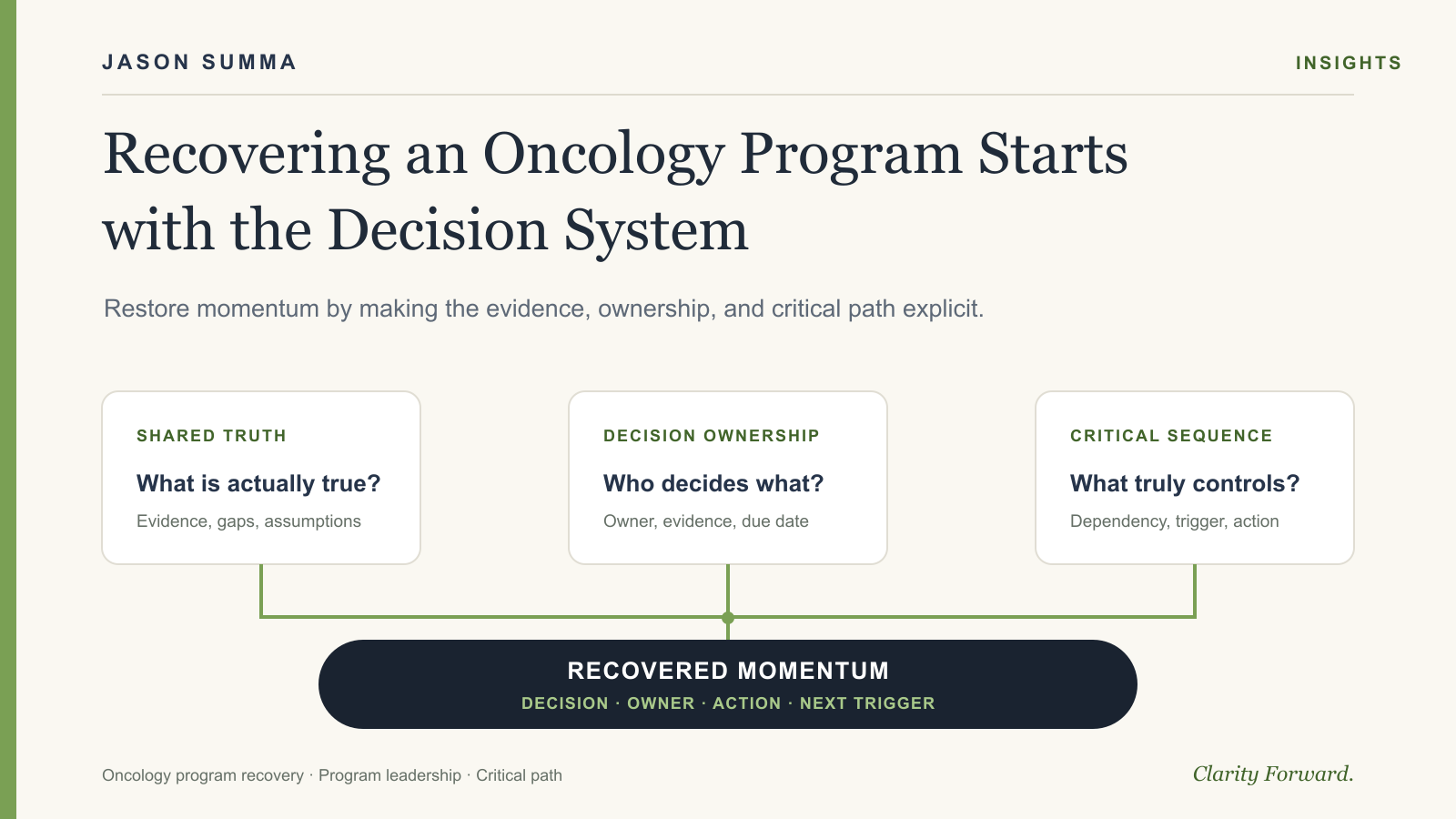
Oncology programs rarely stall because people stop working. More often, the organization remains intensely active while the path to the next meaningful decision becomes less clear.
Timelines are updated. New analyses are requested. Vendors are pressed. Meetings multiply. Each function may be making reasonable local choices, yet the program as a whole continues to lose time.
This is a decision-system problem. The evidence is interpreted differently across teams. Assumptions have become embedded in the plan. Ownership is distributed without clear decision rights. The critical path describes activities but no longer explains what truly controls the milestone.
Recovery begins when leadership makes those conditions visible and rebuilds the operating system around the decisions that matter.
Start with shared truth, not a revised timeline
The instinct in a delayed program is to produce a new schedule. But a revised date has limited value if the organization has not agreed on why the prior plan failed.
The first recovery deliverable should be a concise, evidence-based statement of the program’s current condition. What is known? What remains unresolved? Which commitments are real? Which dates depend on assumptions? Where is the plan already inconsistent with clinical, regulatory, CMC, or operational reality?
This assessment should be factual without being punitive. Recovery slows when teams use the process to defend prior choices or assign blame. The goal is not to establish who was wrong. It is to create a version of reality that every function can use to make the next decision.
Find the decision hiding behind the delay
A delayed activity is often the visible symptom of an unresolved choice. Site activation may be slow because the site model was never reconciled with the patient population. A protocol amendment may cycle because the development objective is contested. Database lock may slip because teams disagree on which unresolved data are material to the analysis.
Asking “Why is this task late?” may generate a tactical answer. Asking “What decision has not been made?” often reveals the program-level constraint.
The recovery leader should identify the small number of choices controlling the next inflection point. Those may include dose or schedule, indication, patient selection, endpoint strategy, geographic footprint, manufacturing readiness, evidence threshold, or whether the program should continue on its current path at all.
Each decision should have a named owner, the evidence required, the date by which it must be made, and the consequence of delay.
Separate commitments from assumptions
Many program plans appear precise because every activity has a date. That precision can hide uncertainty. A first-patient-in target may depend on regulatory feedback, final drug-product release, contract execution, central-lab readiness, and sites with access to a narrowly defined population. If those conditions are represented only as dates, the plan looks firmer than it is.
Recovery requires classifying the plan:
Fact
A completed event or verified condition supported by current evidence.
Assumption
A condition the plan depends on but has not yet demonstrated.
Commitment
An owned deliverable with a credible basis, due date, and escalation path.
This distinction changes the conversation. Leadership can decide which assumptions to test, which to carry explicitly as risk, and which make the current plan untenable. Teams stop treating optimism as a dependency-management strategy.
Rebuild one critical path
A troubled program often has multiple plans: the clinical timeline, the regulatory submission schedule, the CMC plan, the vendor plan, the budget forecast, and an executive milestone slide. Each may be internally coherent while disagreeing with the others.
Recovery requires one integrated critical path anchored to the next value-defining decision. It should connect the minimum set of cross-functional dependencies that control that outcome. Every activity does not need executive attention. Every controlling dependency does.
The critical path should make three things obvious:
- What actually controls the milestone. The answer may be a decision, a dataset, a manufacturing release, a regulatory interaction, or an operational condition—not the most visible workstream.
- Where the uncertainty sits. Ranges, triggers, and confidence levels are often more useful than a single deterministic date.
- What leadership can change. Additional resources, narrower scope, parallel work, sequencing changes, or an earlier decision may alter the path; pressure alone usually does not.
This is the same discipline that strong governance applies to portfolio choices: the purpose is to produce a decision, not a more elaborate update.
Restore ownership at the interfaces
Program risk accumulates between functions. Clinical may be waiting on CMC. Regulatory may be waiting on clinical rationale. Data management may be waiting on medical review. A CRO may believe a decision rests with the sponsor while the sponsor assumes the CRO is driving it.
Functional accountability alone does not resolve these interfaces. The integrated plan needs an owner for each cross-functional dependency and a clear route for decisions that exceed that owner’s authority.
This does not require centralizing every choice. It requires making decision rights explicit. Teams should know what they can decide, what must be recommended, what evidence is needed, and where an unresolved tradeoff will be settled.
Shorten the planning horizon while increasing rigor
When confidence in the plan is low, a detailed twelve-month schedule can create false assurance. A better recovery model is often to plan the next four to eight weeks at high resolution while maintaining the longer horizon as a scenario.
The near-term plan should focus on the decisions and dependencies that will either restore or invalidate the broader path. Progress is measured by uncertainty retired and decisions enabled—not simply by tasks completed.
A practical recovery cadence can be built around five questions:
- What changed in the evidence or assumptions?
- Which decision is now at risk?
- What is the current controlling dependency?
- Who owns the next action, and by when?
- What requires leadership resolution rather than further analysis?
This creates urgency without substituting speed for judgment.
Protect the scientific question during recovery
Schedule pressure can invite simplification that saves time on paper while weakening the program’s ability to learn. Removing an assessment, broadening eligibility, compressing follow-up, or accepting lower data completeness may accelerate an activity but compromise the evidence needed for the next decision.
Recovery leaders must distinguish between waste and essential work. The objective is not to preserve every element of the original plan. It is to preserve the integrity of the clinical question while removing work that does not materially contribute to it.
This is where clinical development, operations, regulatory, CMC, data, and program leadership must work as one system. A recovery plan is credible only if it is scientifically sufficient, operationally executable, and explicit about the uncertainty it carries.
Recognize when recovery means changing direction
Not every program should be returned to its prior trajectory. Sometimes the evidence no longer supports the indication, dose strategy, trial design, partnership model, or program itself.
A genuine recovery process must allow for narrowing, redesigning, pausing, partnering, or stopping. If the only acceptable outcome is a new date for the old plan, the organization is not recovering the program; it is preserving a commitment after its assumptions have changed.
Strong leadership makes that possibility discussable. It brings the evidence, alternatives, tradeoffs, and decision into the same room—then records what was chosen and what would trigger the next review.
Momentum is an output of clarity
Programs recover when teams can see the same reality, understand which choices matter, and act through a credible sequence. The work may remain difficult. The timeline may still be longer than originally hoped. But the organization has regained the ability to make deliberate decisions rather than accumulate delay.
The first sign of recovery is not a greener dashboard. It is a sharper conversation: this is the evidence, this is the decision, this is the owner, and this is what happens next.
Sustainable momentum does not come from adding pressure to a broken plan. It comes from rebuilding the decision system that moves the program forward.